

Bellydancing with P.C.O.S.
- maryemsahar
- Aug 20, 2022
- 10 min read
Updated: Aug 25, 2022
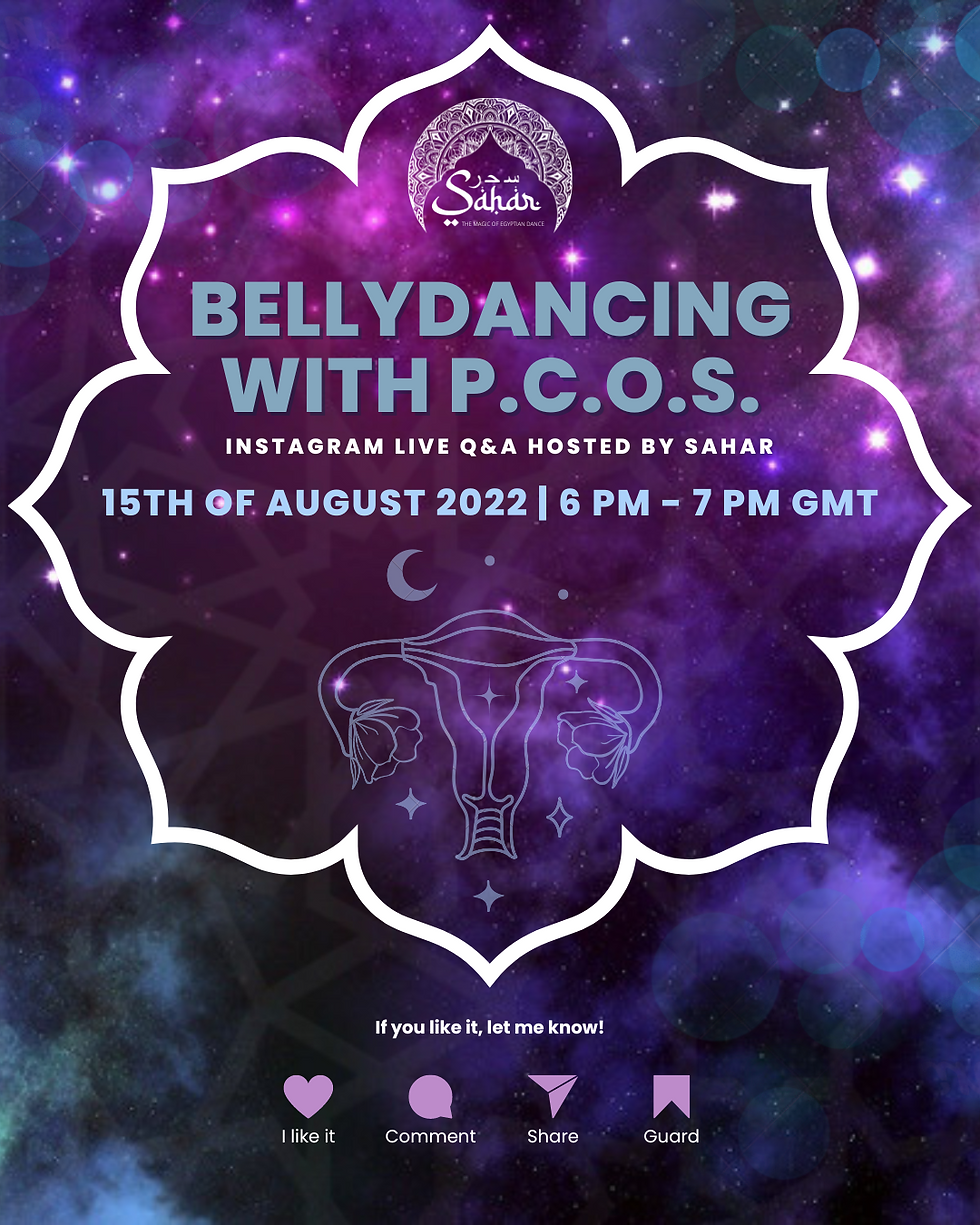
Hello Beautiful People! I hope you are enjoying life!
This time I am coming to present you my new project Bellydancing with PCOS.
It is a project that aims to promote awareness about Polycystic Ovarian Syndrome (P.C.O.S.) and as well Egyptian Dance. Not only that, it is a project that wants to promote a safe space and well being through Egyptian Dance for Women struggling with hormonal and gynaecological wellness. Indeed, it is a project where Egyptian Dance is, once more, a tool for Female Empowerment. Neither the less, it is my safe space to share my professional experience as a(n Egyptian Dance Performer) struggling with P.C.O.S.(amongst others!).
Bellow is an adapt version of the copywrite I used for my my first Life Q&A about this topic. The script's excerpts were taken from several medical literatures, which I forgot to mention right after copy pasting it, but I am leaving here, at the end of this post, all the links I used to study and gather the information about the topic. I hope you find it helpful and useful.
If you do have any doubts please feel free to reach out . Also, don't forget to like it, comment it, share it and guard it. This is how you will help to support and grow my work.
DISCLAIMER: I AM NOT A MEDICAL PROFESSIONAL. I AM JUST SHARING MY PERSONAL AND PROFESSIONAL EXPERIENCE. I AM ALSO SHARING MY KNOWLEDGE ABOUT BELLYDANCING WITH PCOS. IF YOU HAVE ANY SYMPTOMS, IF YOU HAVE PCOS OR OTHER HORMONAL HEALTH RELATED SYMPTOMS AND/OR CONDITIONS PLEASE CONSULT A SPECIALIST. THE INFORMATION I AM ABOUT TO SHARE IT WAS GATHERED IN MEDICAL LITERATURES.
Before we talk about my experience as an Egyptian Dance Performer with P.C.O.S I would like to firstly introduce you to what it is P.C.O.S. and what it is Egyptian Dance. This life Q&A took over 1.30h so it would be impossible to address all the questions and topics involving this matter in one session. So many questions were left out and others arose after this life Q&A. I will host again another life Instagram Q&A about Bellydancing with P.C.O.S. and I hope we can start merging this two different experience into one topic.
So let us first talk about P.C.O.S. ...
1) What it is PCOS?
PCOS is a cluster of health conditions. It is a heterogeneous endocrine disorder impacting women’s metabolic and hormonal functions. It has great expression on the Gastro-intestinal and Genitourinary systems. But not only. PCOS can impact other body functions leading to sever health consequences and conditions which I will mention next. PCOS is characterized by elevated androgen levels, menstrual irregularities, and/or small cysts on one or both ovaries
2) Which are the main signs and symptoms of PCOS?
Irregular periods or no periods at all.
Difficulty getting pregnant (because of irregular ovulation or failure to ovulate)
Excessive hair growth (hirsutism) – usually on the face, chest, back or buttocks.
Weight gain.
Thinning hair and hair loss from the head.
Oily skin or acne.
NOTE: These symptoms can indicate more serious health conditions. Hair loss is not going to kill anyone, but it can be a consequence of a more severe illness. If not looked after it can be life threatening and it can impact quality of life.
3) Which were my main symptoms that lead me to consult a specialist?
Irregular periods. I had months I missed my period.
Excessive hair growth mainly on my chin but also on my upper lip, belly button line and on my arms, etc.
Suddenly gaining a lot of weight despite eating healthy and dancing professionally, training and exercising daily.
I was losing a lot of hair. My hair was oily, my scalp was itchy and was getting thinner by day.
I was always tired and more emotional
My skin was oily and I started to have acne on my chin
4) How PCOS is diagnosed?
If PCOS is suspected, a complete medical history, physical examination, blood tests, and a pelvic ultrasound should be performed. A medical history and physical examination provide the physician with information about unexplained weight gain, menstrual cycle abnormalities, male-pattern hair growth, skin changes, and elevated blood pressure (BP). Blood is drawn to assess hormone, glucose, and lipid levels, and a pelvic ultrasound is performed to scan for ovarian cysts. During the assessment period, other potential causes associated with reproductive, endocrine, and metabolic dysfunction should be excluded. Physicians should rule out adrenal hyperplasia, Cushing’s syndrome, and hyperprolactinemia before a PCOS diagnosis is confirmed. When diagnosing PCOS these parameters should be investigated:
Hyperandrogenism (signs of virilization eg: excessive hair growth)
Oligo-ovulation/anovulation
Polycystic ovaries
Exclusion of other related disorders
5) How and when was I diagnose?
I was diagnosed around 2012 I was 24 years old.
I consulted an Endocrinologist. He prescribed me blood tests, he excluded other health conditions and he also requested me to do a vaginal scan.
6) What causes PCOS?
Most of the symptoms of PCOS are caused by higher-than-normal levels of certain hormones, called androgens.
The ovaries produce hormones, which are chemicals that control functions in the body. One of the hormones that the ovaries make is oestrogen — sometimes called the "female hormone" because women's bodies make more of it than men's bodies do. The ovaries also make androgens — sometimes called "male hormones" because men's bodies make more of them than women's bodies do. Men and women need certain levels of both hormones for normal health.
In women with PCOS, the hormones are out of balance: these women have higher-than-normal levels of androgens and may have lower-than-normal levels of oestrogen. High levels of androgens can:
Interfere with signals from the brain that normally result in ovulation, so that ovulation does not occur regularly
Cause the follicles—small, fluid-filled cysts within the ovaries in which eggs grow and mature—to enlarge, forming cysts
Produce other symptoms of PCOS, including excess hair growth and acne
Other symptoms of PCOS result from problems with insulin, another of the body's hormones. Insulin helps move sugar (also called glucose) from the bloodstream into cells to use as energy. When cells don't respond normally to insulin, the level of sugar in the blood rises. In addition, the level of insulin goes up as the body produces more and more of it to try to get glucose into the cells. Too much insulin increases the production of androgens,5 which then cause symptoms of PCOS. High levels of insulin can also increase appetite and lead to weight gain. High insulin levels are also linked to a skin condition called acanthosis nigricans, which results in thickened dark, velvety patches of skin
7) Which are the consequences of having PCOS?
After PCOS is diagnosed, studies show that more than 50% of patients develop prediabetes or diabetes, and there is an increased risk of myocardial infarction (MI), dyslipidemia, hypertension, anxiety, depression, endometrial cancer, and sleep apnea. Moreover, pregnant women with PCOS should be informed of the increased rates of miscarriage, gestational diabetes, pre-eclampsia, and premature delivery.
8) Which Are the PCOS consequences in my case?
Gastro-intestinal: chronic gastritis and colitis, IBS, NAFLD. Vit D and Folic Acid Anaemia
Endocrine: type 2 Diabetes and Hormonal imbalance
Genito-Urinary: Difficulty in getting pregnant, Multiple Ovarian Cysts and Adenomyosis
Rheumatic: Fibromyalgia and Spondylosis, broken misplaced backbone and Carpal tunnel Syndrome
Chronic Pain and Fatigue Mental Fog
Insomnia and Depression
9) Does PCOS have a cure?
It does not have a cure, but it can be controlled if living a healthy lifestyle by managing stress factors, eating healthy and exercising. On a best scenario one can reverse the syndrome. It is not impossible, but it is very demanding.
10) Which treatments are available?
Because the primary cause of PCOS is unknown, treatment is directed at the symptoms. Few treatment approaches improve all aspects of the syndrome, and the patient’s desire for fertility may prevent her from seeking treatment despite the presence of symptoms. Treatment goals should include correcting anovulation, inhibiting the action of androgens on target tissues, and reducing insulin resistance.
Weight reduction for obese patients with PCOS is beneficial in many ways. Weight loss helps to decrease androgen, luteinizing hormone (LH), and insulin levels. It also helps to regulate ovulation, thereby improving the potential for pregnancy.
Laparoscopic ovarian drilling is an outpatient surgical intervention in which multiple perforations are created in the ovarian surface and stroma. It is thought that this intervention destroys androgen-producing tissue, which should lead to decreased androgen levels. It has been found to be as effective a medical interventions without increasing the risk of multiple pregnancies.
11 ) How PCOS impacts Woman’s quality of life?
Polycystic ovary syndrome (PCOS) is a chronic condition with symptoms affecting many women at reproductive age and evaluating their health-related quality of Life (HRQoL) is an important issue. In my personal opinion this has been neglected
Polycystic ovary syndrome (PCOS) is the major endocrine related disorder in young age women. Physical appearance, menstrual irregularity as well as infertility are considered as a sole cause of mental distress affecting health-related quality of life (HRQOL). Not only that, women with PCOS are more prone to depression.
In PCOS cases, socioeconomic status was comparable in comparison to healthy control. But, PCOS cases showed significantly decreased HRQOL. The higher age of menarche, irregular/delayed menstrual history, absence of child, were significantly altered in PCOS cases than control. Number of child, frequency of pregnancy, and miscarriage were also observed higher in PCOS cases. Furthermore, in various category of age, BMI, educational status and marital status, significant differences were observed in the different domain of SF-36 between PCOS and healthy control. Altogether, increased BMI, menstrual irregularities, educational status and marital status play a major role in altering HRQOL in PCOS cases and psychological care must be given during patient care.
In addition I would like to add that chronic pain levels has to be considered in HRQOL studies.
Ok so after we talk a bit about what it is P.C.O.S. I want to introduce you to Egyptian Dance (for the ones who don't know what it is) and I will start merging this two matters in one topic. I hope you start getting my vison. Now let us talk about Egyptian Dance...
1) What it is Egyptian Dance?
I will leave you with my blog post about what it is Egyptian Dance. This is a more complete article on the topic.
I sum, Egyptian Dance is what we erroniously call "Bellydance". The correct term translated from te arabic expressions "Raks Sharki", is Oriental Dance.
https://maryemsahar.wixsite.com/website/post/egyptian-oriental-dance-history-resume
2) When did I started to practice?
I was 13 years old. I will quote what I wrote for my website bio:
" The first contact I had with the Egyptian Dance was in 2000/2001 and it was LOVE at first... "listen"!!!
The music had touched my soul and awoke an eternal love which would influence all my artistic expression, career and LIFESTYLE!!! This was the beginning of The Journey, a Life Journey through my own body and soul, a Journey embraced by the heavenly sounds and rhythms of The Middle East Culture but above all from Egypt. "
Find out more about me here: https://maryemsahar.wixsite.com/website/about
3) Egyptian dance fertility rituals
Here is a excerpt from my blog post about the origins of Egyptian dance (below you can find the link to the original post).
"Following this line, Raks il Sharki relies its essence in an ancestral form of ritualistic motion which relates to the (Pre-) History of Mesopotamia and has a great (social) relevance within the culture of ancient civilizations like the Sumerian and Egyptian Empires, when this kind of rituals full-blown. During those periods some pagan societies used to worship (a) feminine(s) deity/(ies), to celebrate women’s fertility as something magic. In fact Art itself is a celebration of life! If we rethink about the original concept of the three main forms of art (Theater, Dance and Music) we can conclude that all three has the same purpose - the reconnection with the cosmos and its creative force. A real connection with a ritualistic nature.
In ancient Mesopotamia, the devotion to the Goddess Mother Earth was deeply developed. It is thought that there were many rituals dedicated to her by " dancing " fertility and the motherhood of all women (goddesses themselves).
With a sincere and authentic re-connection, an earthly energy was celebrated from womb to womb, from women to earth – The Great Goddess, our Mother Nature, as so empowering the root energy of our body as a hole and vital mechanism with mystical powers: the Vagina, The Pelvis, The Womb, Nintud/Nintur ( the Sumerian deity appears to be the most prominent name for the Mesopotamian mother goddess who is also known under many other names ) - The Force of Creation.
In ancient Egypt, Hathor, who personified the principles of joy, feminine love, and motherhood, was one of the most important and popular deities in the Egyptian Panthenon, being worshiped throughout all History of Egyptian civilization. She was the Goddess of the sky, dance, love, beauty, joy, motherhood, foreign lands, mining, music and fertility.
It is proposed that Oriental Dance descends from a religious dance performed during fertility rituals by temple priestesses. Temple engravings depicting dancers have been found in Mesopotamia, Egypt, and Greece as early as 1000 B.C.
Considering all these aspects, it is natural for me to say that Raks ( il ) Sharki, as a folk dance, is the womb of all dances because it carries within itself the cradle of Mankind’s History and as well The Fertile Crescent itself, Mesopotamia."
BLOG POST ABOU THE ORIGINS OF EGYPTIAN DANCE: https://maryemsahar.wixsite.com/website/post/egyptian-oriental-dance-history-resume
4) Belly dance and Pelvic Muscles
Bellydancing, or better saying, Egyptian Dance is a great workout for anything related to pelvic muscles and its well being. It is a great exercise to help with Pregnancy as it will help labour by providing a stronger core and a greater pelvic muscle awareness. It will help with chronic pelvic pain as certain movements can provide a relief by massaging our organs. It will help you with the loss of sexual drive by driving more blood to your pelvic area as so activating blood circulation , which is much needed for lubrication and erection. ESome of the movements in Egyptian Dance can be compared to the ones practiced during Kegel exercices (vaginal gymnastic) and a well as Pompoirism.
5) Benefits of OD
The benefits of practicing Egyptian Dance are many. I will leave you with another blog post this time around about this matter which I am certain you will appreciate. It is very complete.
https://maryemsahar.wixsite.com/website/post/bellydancing-health-benefits
6) How OD helped me?
Physically: weight management, endurance, feeling light, detoxed, pain management, body awareness (in touch with my self). I feel very self aware which helps me being aware of my symptoms. Balance and coordination, posture, drink more water and to eat better, it helped me with my digestion. Cramp management. It help me when I struggled with my sexual drive and reproductive problems.
Intellectually: Observation, I had to learn how to learn by just observing other dancers performing. To listen it help me with my musicality awareness/ mental gymnastic. It boosted my creativity and artistic sensitivity.
Psychologically and Emotionally: It helped me build up by my personality by reading more about Oriental Mysticism and Spirituality, leaning and getting in contact with other culture(s), by creating professional values and standards that I started to practice as well on my personal life (walk the line). It boost myself esteem and it saved my life from so many dark places because it gave me pleasure in pain, a reason to life and fight back, to love myself and it allowed me to know empowered and empowering people who inspired me to be a better person but above all to be my own woman my goddess and to experience my body, my existence and life as a sacred space, time and event in the present. It grounded me.
I hope you enjoyed the reading and please don't forget to follow me on my Instagram @bellydancersahar. I will leave you as well with the link to the our Q&A here. Sending Love to y'all.
Sahar <3
All medical literatures:
https://www.hopkinsmedicine.org/health/conditions-and-diseases/polycystic-ovary-syndrome-pcos





Comments