

Oriental Dance - History resume.
- maryemsahar
- Jan 31, 2020
- 22 min read

TERMINOLOGY
The origin of the name Bellydance comes from the french term Danse du ventre, which literally means dance of the womb.
Considering the studies done on the subject, it is not clear when was used for the first time. Although, and in my point of view, the term seems to be associated with the Middle Eastern conquers of the French Napoleonic Empire as well as with the Orientalism movement of the 18th and 19th century which came to instigate the curiosity and passion for the Middle East. It is due to so many artists like Jean-Leon Gerome that nowadays we have several dance records and social representations of that time, however they were a product of the author's imagination.
In 1899, the name Danse du Ventre, gain its popularity with the " Exposition Universelle de Paris", an international fair that brought to the eyes of the public La Rue du Caire & les Almees - a recreation of Cairo's streets and its traditional dancers.

A few years later, America celebrated the World's Columbian Exposition, following the French example. Sol Bloom is said to have been the first one to use the English term Bellydance, for the dancers of the Chicago’s World Fair in 1893.
Bellydance is also often referred to as “Oriental Dance” and also sometimes Raks (il) Sharqi. This is the Egyptian Arabic expression for “Dance of the East”, therefore Oriental Dance.
Although, the term Bellydance seems to be the most famous nomination for this dance, it is in fact considered an erroneous definition as it had originally racist connotations.
Currently, experts' opinions are divided about whether it should still be used nowadays. Some say the term has lost its racists connotations and that in fact it is the most known way of naming this dance. Others says it should be avoided and replaced possibly with Oriental Dance.
In my opinion, when we talk about this dance, we are referring to a Middle Eastern Ethnic and Cultural expression which uses dance and music as a non-verbal language therefore we should respect and stick to it. In these matter, Egyptian dancers are very clear, the right term to be used is indeed Raks il Sharki, Oriental Dance.
Of course, and naturally, dance as a cultural expression takes on several aspects, as communication itself.
If we compare it to a river, we could name this same river, for example, (Egyptian) Oriental Dance. The expression Oriental Dance is a Western translation of the Arabic Egyptian term Raks il Sharki and it refers to a traditional dance, enhanced as a spectacular cabaret performance, that has also been adopted and adapted by Turkey, Lebanon, and Greece (each country has their own nomenclatures and characteristics).
Nowadays, the term Oriental Dance, is used globally by western dancers, who adds certain specifications to the expression itself, as for example, (Turkish) Oriental Dance in order to define their art. Terms such as Egyptian Dance, etc., are no more than a reference to the traditional dances of a country, as so including its own classical and folk dance(s) underneath this term (eg: Raks Sharqi and Saidi). Now, let us think that each of these countries are an independent river with their own springs and currents, as so Egyptian Dance is the spring and Oriental Dance is one of its rivers and so on.
As for the term Bellydance, some use it because it is a very popular and commercial name that ends up by summarising all of this aspects into a dance concept which we are all familiar with. Although, and as mentioned before, it is a Western term that does not do justice to or even represents its cultural context, especially since it is, in fact, a Western approach to the Middle East, an Ocidental dance stylization but, above all, a reduced term that does not express the cultural richness of Eastern Dances.
As for these rivers, and their tributaries, they flow and contribute to the cultural ocean we name it Bellydance, which is nothing less than a medley of Middle Eastern traditional dances and whose fusion is the result of the convergence between western cultures and its performing arts with the traditions of these countries.
In my professional case. I like to describe what I do as Egyptian Dance, either if I am referring myself to a more spectacular side of it - Egyptian Oriental Dance, either if I am referring to its folkloric dances as for example Raks Beledi (which is the most popular dance style in Egypt). I don't dance Turkish or Lebanese Dances.
As well. it is worth saying that Bellydance or Oriental Dance does not have nothing to do with the American dance Hoochie-Coochie, a catch-all term to describe any of a number of sexually provocative bellydance-like dances, with which Oriental Dance was associated to during the 19th century onward.


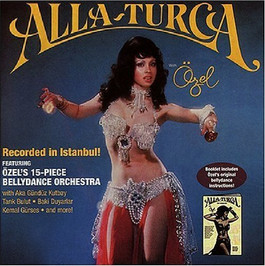


BUT... WAHT IS ORIENTAL DANCE???...
DEFINITION, TERMINOLOGY AND DANCE STYLES
Oriental Dance (from the Egyptian expression Raks il Sharki - literally Dance of the East, therefore, Oriental Dance) is a traditional folk dance with several manifestations throughout Middle Eastern countries and as well as Near East, Asia, North of Africa and The Mediterranean, having which country its own nomenclature and dance aesthetics, although its original style comes from Egyp.
In Egypt the dance is known by Raks il Sharki, in Turkey by Oryantal Dans, in Lebanon as Warda Wa Noz and in Greece is Tsifteteli. Below there is a brief explanation about the different styles:
- Egyptian Oriental (also labeled as Raqs Sharki) as we know it today, originates from the early 20th century in Egypt. From the beginning, raqs sharqi incorporated baladi and folkloric movements, as well as western influences. The style tends to be fluid without much isolation and is rich in emotion and music interpretation, even the smallest movement in raqs sharqi is quite dramatic. The style can be further subdivided into three categories, Classical (1930- 40s), Modern (late 1940s-90s) and Post Modern (1990s- present). Egyptian Oriental Dance includes some ballet and ballroom dance influences, such as in footwork (for example the use of arabesque), in stance and arm positions, however adapted to an oriental style. Floorwork and certain pelvic moves are banned, due to Egyptian law.
- The Turkish style of Oriental Dance (also known as Oryantal Dans, or simply Oryantal) is closer to its Romany (Gypsy) heritage than Egyptian and Lebanese styles. It is flamboyant and dynamic, lively and playful, with a greater outward projection of energy than the more contained Egyptian style. Turkish dancers are known for their energetic, athletic (even gymnastic) style, and their adept use of finger cymbals, also known as zills. Floorwork, which has been banned in Egypt since the mid-20th century, is still an important part of Turkish bellydance.
- Lebanese Oriental Dance is a convergence of the Egyptian and Turkish styles. It takes from the Classic Oriental Dance, but is different from its Egyptian neighbour. The basic moves are the same but the styling, musical interpretation, and folkloric traditions developed separately. Hoewever, it still incorporates a feisty, modern edge. There are large steps, backward leans to the torso, twisting hip rotations, large and busy arms and lots of shimmies. The Lebanese style also uses Western Dance elements, Debke/dabka (folkloric line dance of the Levantine region), upward hip articulations, glut accents, and Khaleeji influences (Arabian Gulf). The types of techniques that are used in the dance are quick layered shimmies and subtle internal movements. Lebanese dancers sometimes includes kicks, splits, deep back bends, and Turkish drops. The larger use of space and faster music is also characteristic of Lebanese Oriental.

In sum, Oriental Dance is primarily a torso-driven dance, with an emphasis on articulations of the hips. In common with most folk dances, there is no universal naming scheme for dance movements. Some dancers and dance schools have developed their own naming schemes, but none of these is universally recognised.
Due to its cultural contribution and the weight it represents to Oriental Dance, Egyptian style will always be its highest, the most famous and authentic manifestation of the dance. Am I too suspicious by saying that?! Well, let me show you why!
THE ORIGIN OF THE DANCE
Although there is a lot of studies about the subject, the Pre-History of Oriental Dance is still involved with mystery (as the dance itself!).
After extensively reading about it and considering the years of History (of Art) learned through my Artistic training as a performer, and as well as Arts' student, I built up the opinion that several aspects and Historical moments contributed to its birth (and, later on, it's development). However, the strongest evidences points to North of Africa.
According to some, the dance form that today many call Bellydance is extremely old and traces of it can be found up to 6000 years ago in Mesopotamia - Neolithic period.
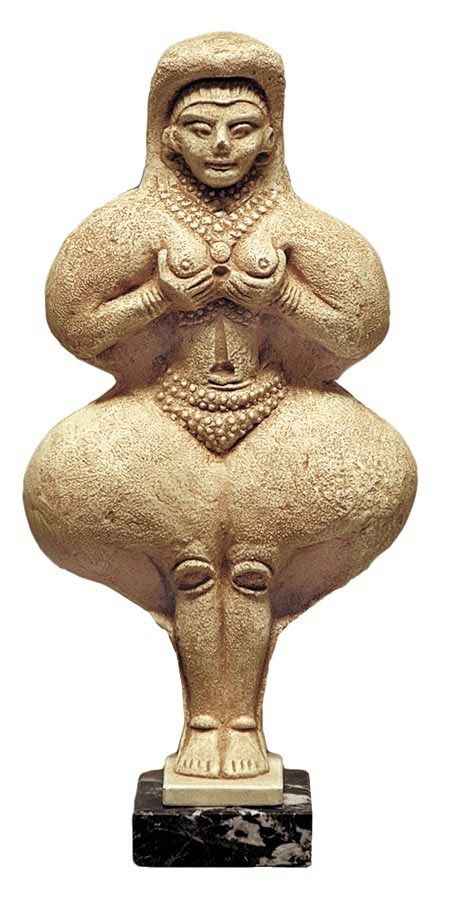
Following this line, Raks il Sharki relies its essence in an ancestral form of ritualistic motion which relates to the (Pre-) History of Mesopotamia and has a great (social) relevance within the culture of ancient civilizations like the Sumerian and Egyptian Empires, when this kind of rituals full-blown. During those periods some pagan societies used to worship (a) feminine(s) deity/(ies), to celebrate women’s fertility as something magic. In fact Art itself is a celebration of life! If we rethink about the original concept of the three main forms of art (Theater, Dance and Music) we can conclude that all three has the same purpose - the reconnection with the cosmos and its creative force. A real connection with a ritualistic nature.
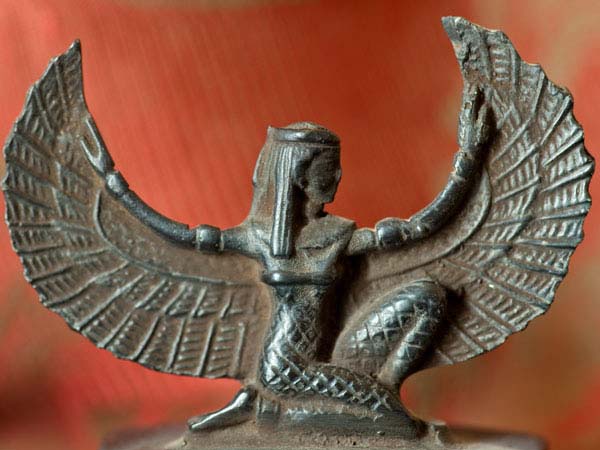
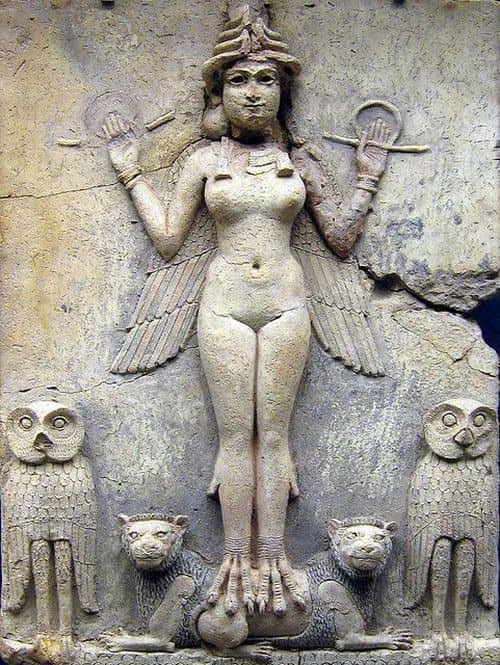
In ancient Mesopotamia, the devotion to the Goddess Mother Earth was deeply developed. It is thought that there were many rituals dedicated to her by " dancing " fertility and the motherhood of all women (goddesses themselves).
With a sincere and authentic re-connection, an earthly energy was celebrated from womb to womb, from women to earth – The Great Goddess, our Mother Nature, as so empowering the root energy of our body as a hole and vital mechanism with mystical powers: the Vagina, The Pelvis, The Womb, Nintud/Nintur ( the Sumerian deity appears to be the most prominent name for the Mesopotamian mother goddess who is also known under many other names ) - The Force of Creation.
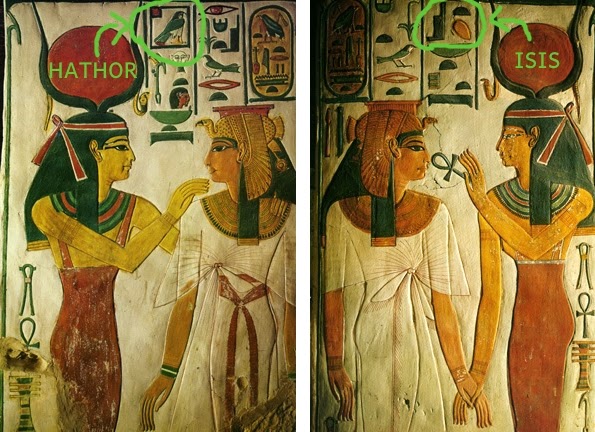
In ancient Egypt, Hathor, who personified the principles of joy, feminine love, and motherhood, was one of the most important and popular deities in the Egyptian Panthenon, being worshiped throughout all History of Egyptian civilization. She was the Goddess of the sky, dance, love, beauty, joy, motherhood, foreign lands, mining, music and fertility.
It is proposed that Oriental Dance descends from a religious dance performed during fertility rituals by temple priestesses. Temple engravings depicting dancers have been found in Mesopotamia, Egypt, and Greece as early as 1000 B.C.
Considering all these aspects, it is natural for me to say that Raks ( il ) Sharki, as a folk dance, is the womb of all dances because it carries within itself the cradle of Mankind’s History and as well The Fertile Crescent itself, Mesopotamia.




THE (NEW AGE) TWIST
Although there is a lot of references pointing towards this direction, the presented theory it is not always welcomed among dance enthusiasts who's opinions vary for me each other. If for one side we have all of this goddess thesis, for another, we have experts affirming that there is little evidence of early pagan rituals being in any way connected to the dance as we know it today! Yes, it is, indeed, a good workout for birth preparation but there does not seem to be proof of any link to ancient fertility rituals. This is because we cannot actually compare and analyse the technical aspects of the dance with the rituals from the past due to the absence of visual or written records.
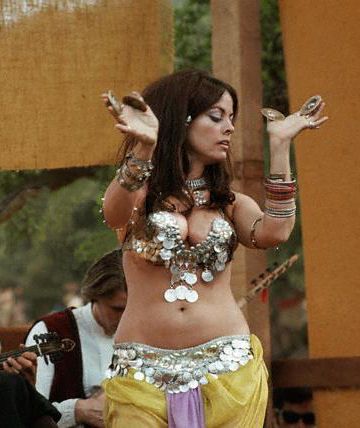
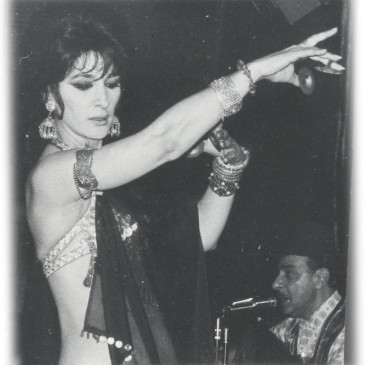
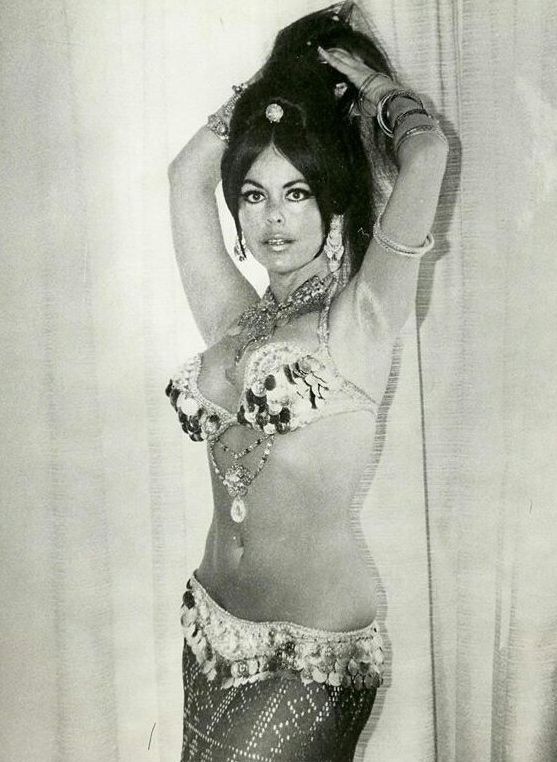
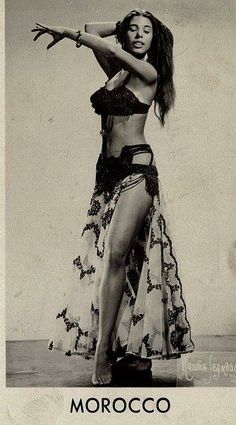
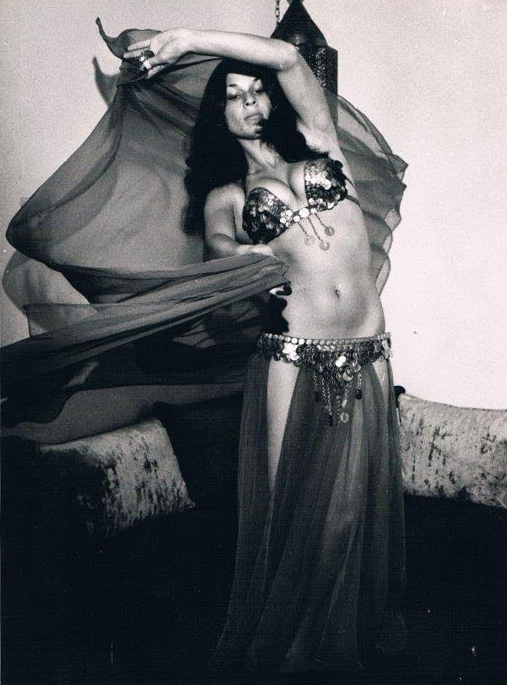
In spite of this, there has been, as well, a tendency to associate Oriental Dance with spirituality and the power of the feminine. The concept has been largely developed in the last 40 years specially by the USA feminist movement, which, between the 1970s and 1980s, rediscovered this dance as a form of empowering women and developing it to what we call today Oriental Dance, American Cabaret Style .







CONTROVERSY AND THEORIES
The origins of Oriental Dance, as the dance itself, it is indeed a controversial issue being constantly debated among dance experts and enthusiasts. Different opinions and theories have been raised which either adds to or contradicts what was previously discussed as so contributing to the valuation of this magical dance.
As mentioned, the most popular theory is that it evolved from a religious dance which was performed during fertility rituals by temple priestesses. Some people believe that it descended from ancient Egyptian social dances, or that Raks Sharqi began as a traditional birthing practice to help ease the pains of childbirth - It prepared girls for labor and was part of the delivery ritual.
Another popular theory is that this dance originated in India over 5000 years ago, and had spread throughout the Middle East with the migrations of the Gypsy tribes, also called Romani in Turkey, Roma in Europe, Ghawazee in Egypt, and Nawar in India - The Gypsies eventually reached Europe where one of the most famous Gypsy Dance styles was born - Flamenco. Many moves in modern Flamenco, and its expressions like the Zambra Dance, are still very similar to Oriental Dance. Although, Egyptians seems to not accept the above theory defending that in fact Oriental Dance came from the time of the Pharaohs.
Many people want to learn about how Oriental Dance originated out of general interest. In my point of view, we have to contemplate Egypt's History and then, when we talk about Bellydance, the richness of Middle Eastern Dance tradition and its universal appeal that can be attributed to the colorful mixture of various sources, cultures, and dance styles as we cannot ignore the evident contributions of these aspects.




FOREIGN INFLUENCE, ORIENTALISM AND THE MYTH OF SEDUCTION (???)
As so, it is worth mentioning the counterpart of the Ottoman Imperial Harem in this beautiful blend, which brought to Topkapi Palace women from different backgrounds to integrate the Sultan's harem.
As Muslim women couldn't be taken as slaves, these girls were brought from different religious and cultural backgrounds being highly educated to serve the Harem and the Sultan. Some would be offered by their families or even offered themselves to the Harem as this was a lifetime opportunity to acquire social status, power and ultimately become a Sultan's wife. Harem girls were initiated in different disciplines including Culinary, Literature, Sexuality and Art. They knew and dominated with high skilled technique subjects like poetry, music and dance.
However, not all the girls would be taken as courtesans, in fact some would occupy a different position in the Harem, which was deeply hierarchical. These girls would become the chambermaids of the Sultan's consorts - they were odalisques.
An odalisque (from the Turkish expression odalık) was not a concubine of the harem, but a chambermaid or a female attendant in a Turkish seraglio (sequestered living quarters used by wives and concubines in an Ottoman household), although it was possible that she could become one. An odalık was ranked at the bottom of the social stratification of a harem, serving not the man of the household, but rather, his concubines and wives as personal chambermaids.
Odalık were usually slaves given as gifts to the sultan by wealthy Turkish men. Generally, an odalık was never seen by the sultan but instead remained under the direct supervision of his mother - The Valide Sultan.
During the 18th century, the Orient and its enchants blossomed to the Western world and as so the dance was exposed for the first time to European's culture.
In 1798, Napoleon sent a military campaign to the Ottoman regions of Egypt and Syria which primary purpose proclaimed to defend French trade interests, weaken Britain's access to British India, and to establish scientific enterprise in the region.
Militarily, the expedition was a colossal and expensive blunder but indeed it opened the eyes of Europe to an ancient civilization and exposed Egypt and the Muslim world to the challenge of different ideas and technology.
Although the French were not successful in Egypt, they annexed Algeria in 1830, Tunisia in 1878, and eventually extended their influence into Lebanon and Syria. Finally, in 1882, the British occupied Egypt and established effective control of the Persian Gulf.
Until the mid-1800s the Eastern territories, particularly Persia, Mesopotamia, Minor Asia and Egypt were collectively referred to as the Orient.
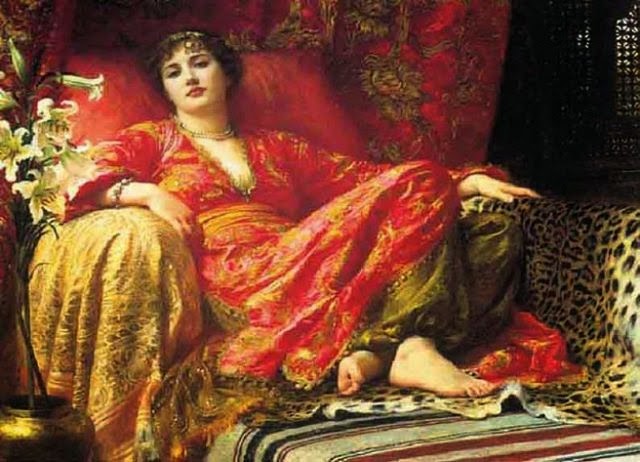
Throughout a series of invasions, Europeans gained greater exposure to the culture of the Middle East and North Africa. The mystique of the East infatuated the imagination of 19th century European painters and writers who came to be called Orientalists. Eugène Delacroix, Jean-Léon Gérôme, and Jean Auguste Dominique Ingres were some of the most prominent figures of the Orientalist movement which often depicted aspects of Middle Eastern, South Asian, and East Asian cultures (Eastern cultures). As so the Ottoman Harem was one of the favorite themes being approached and probably the most being portrayed.
In this way, the Orient was unveiled to the world and the world to the Orient.
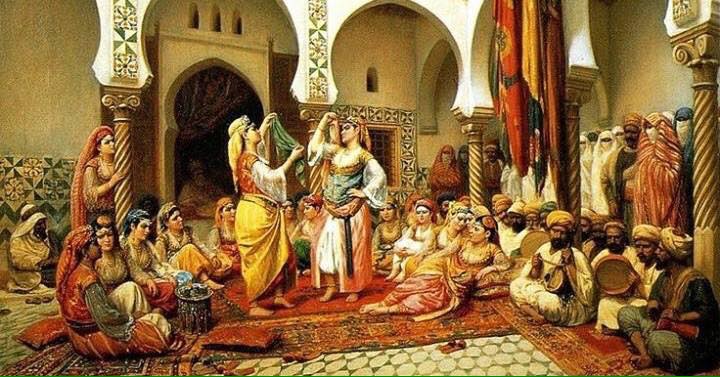
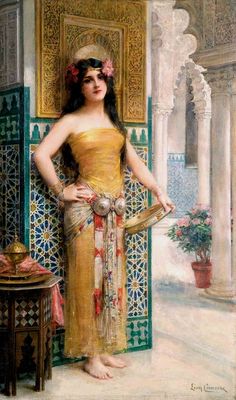
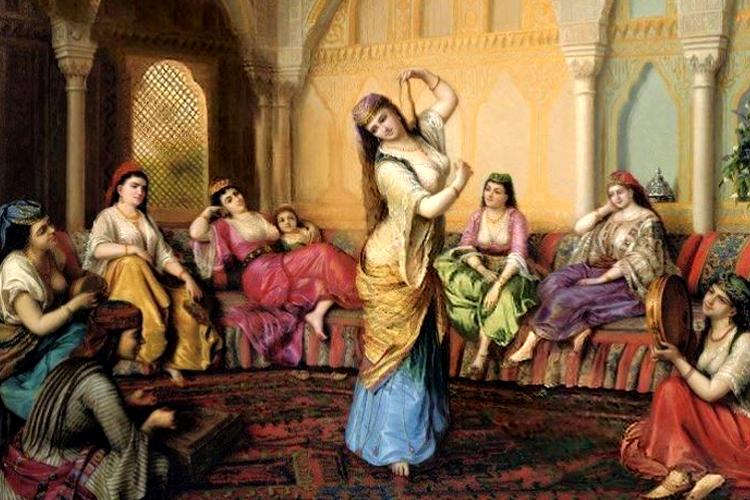
However, Orientalist portraits were highly eroticized as they represented fantasy scenes from the harem life: semi-naked concubines, reclining on pillows with swaying peacock fans, dancing for the pleasure of a sultan or a group of men. These works would tell a different reality of Middle Eastern culture and to the role that dance played in it.
As mentioned before, not all the girls in the Harem where chosen to become the Sultan's courtesans. In fact Harem girls didn't had much access to exterior life and the only masculine contact they would have was with the eunuchs, castrated slaves brought into the harem to guard its servants.
So when and where dance was allowed?
Harem per se was, profoundly, a feminine environment, women would dance among, between and for each other as social acquaintanceship. All the men allowed into the harem were castrated - not even the Sultan was allowed. The access to the emperor was merely for entertainment proposes in special occasions or upon Sultan's request. Any girl who got involved with another man was chopped in to pieces, sack and thrown to the waters or simply putted in a sack and drowned alive - "The Turkish method".
As we can see, the Orientalist movement had undoubtedly contributed to the popular misconception of Oriental Dance as a dance of seduction, performed for the pleasure of men. In fact, because of the traditional gender segregation, in some strict cultures or families, Middle Eastern women usually only dance in female company, among friends and family. Sometimes a professional dancer and musicians are invited to a women's gathering. Today, gender segregation is not as strictly practiced in many urban areas, and occasionally both men and women dance socially at family or community events.
Unfortunately still exists a lot of prejudice about dance and arts in general (not only in the Middle East!). In Islamic cultures, a woman who aims to become a Rakassa (dancer) is taken by the culture and her family as a shameful woman. Same with men who sees their gender and sexuallity questioned.
Both will face the scepticisms and the side looks of society - unless they prove their talent and worth by becoming a top performer.
However, there is always a "blessed" soul to point out their fingers and gossip about it!
I am happy to say that, as in everything in life, exceptions exists showing us that in darkness we can still experience the light of awaken hearts - who makes the difference in this world and in the profession as well!
Going back to the subject... But why we still face this ghost? Because there is always the other side of the coin!
Backing to Ottoman Empire, Harem women would hire dancers from outside of the Palace. They were traveler women known as çengi.
At some point women were prohibited of dancing in public and, therefore, çengi were only seen dancing for female audiences. As a consequence of this banishment men took their place and started to perform being known as köçeks.
While the çengi only performed in private settings, the köçek performed in public as well as in the court.
Either the köçek, either the çengi, have been associated with prostitution and homosexuality. They were said to have pleased the Ottoman Court with sexual services as well as the men attending the taverns were they used to perform.
As lately women were stopped from acting publicly, the köçek have been associated with transvestism and homosexuallity. Their beautiful looks, mesmerizing presentations and their realistic drag skills are said to have deceived men who would feel attracted to their charms - they were pointed as "sensuous, attractive, effeminate", and their dancing "sexually provocative". The köçeks were available for sexual entertainment, often to the highest bidder.
In the other hand, çengi were associated with prostitution but mainly with lesbianism as, later, they were restricted to female audiences. In Ottoman çengi dancing, women dressed as men to play male roles in dances featuring roles for both genders.
With different Historic details, the same has happened in Egypt with its court and social dances, specially during the expansion of the Ottoman Empire to Egypt and Middle East.
Since ever prostitution has been a way of (social) "entertainment" for men and women and practiced by both genders.
What people do with their own bodies and life's decisions is up to them.
We can not stop a prostitute of using dance or any other kind of performing art as a way of promoting her services and "entertaining" customers. We cannot define sexual orientation through art. In the same way we cannot define art by the artist's personal life regardless the ways and methods used to make a career.
People carry the weight of their actions and personal choices, as so to judge an artist and his/her art as frivolous it is completely unfair, preconceived, outdated, etc...
There is always an intention behind art in the same way that there is always an intention behind seduction. It will always depends on the way we present ourselves, our work, our life choices and the public we choose.
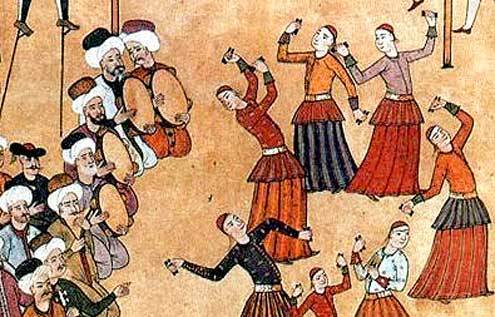
As we can see, the Ottoman Empire dancing was a form of entertainment enjoyed both at court and amongst ordinary people. Unfortunately these dance traditions have not survived to the present day, and our information about them is restricted mainly to Ottoman miniatures and drawings and paintings by Europeans. When exploring the History of Ottoman Dance it is important not to confuse such authentic documents with the works of European Orientalist painters, who depicted not what they had seen but what they imagined.









SOCIAL DANCE AND ENTERTAINMENT
If we take a brief look to the History of Middle East we can easily understand that music and dance were always intrinsically connected to its daily life.
People would celebrate any kind of happening while dancing away their emotions and passions (applying here the Greek philosophical meaning).
As per se, Oriental Dance is a moment of (re)joy, feelings, pleasure and reunion - engagements, births, weddings, social gatherings and family reunions are the main social events where a dancer's presence is always required and cherished by its audience, which as well takes part of it.
When gathering together, women dance for each other as a way of socializing. In certain cultures women still chooses the potential brides for their sons according to the way the girls dance.
But not only women dance together, men as well has their own social gatherings and celebrations where we can observe their way of dancing and celebrating life.
Neither the less, Oriental Dance is a transverse social dance celebrated from women to women, man to men and between both genders WITHOUT ANY KIND OF (GENDER) CONNOTATIONS OR PREJUDICE.
In Egypt the popular dance that we can observe at wedding celebrations, danced socially by people attending parties and professionally by performers who are paid to dance for special occasions, is the typical baladi dance.
From the Egyptian Arabic, Baladi means local, of town, popular, rustic (in a sense of being authentic) and rural (in a sense of belonging to a village or population), being comparable to the English term folk.
However, in Egypt the word itself does not only apply to music and dance, but in fact to many other things that are considered native or traditional - like fruit, vegetables and bread. Indeed, it has been as well used to refer to an Egyptian musical style, the folk style of Egyptian Oriental Dance (Raqs Baladi), or the Masmoudi Sogheir rhythm, which is frequently used in baladi music.
Nowadays, the music played most commonly at weddings and social gatherings in Egypt is Shaabi which is very similar to Baladi Dance but it does not have the same structure - Shaabi music is composed by individual pop songs, while baladi is mainly instrumental music improvised with a set pattern, hence a Baladi Dance performance follows the same pattern translated into movement.





What we call today Raks Sharqi has always been a form of public entertainment.
But...
HOW COME ORIENTAL DANCE BECOME (A PERFORMING) ART?
THE SHOWBIZ
As a performing art, Oriental Dance made its way many centuries ago.
Beautiful as life itself, it is a colorful mix, a chameleon in a shape of dance. We owe its richness to several social structures with different dynamics, social positions, geographical locations and Historical periods.
Previously it was mentioned the importance of the Ottoman Harem which brought into scene courtesans slaves from different backgrounds who were educated in multiple artistic areas.
As well, it was denoted the relevance of traveler groups who used to perform publicly and also were hired to entertain the Sultan and his court with their charms and talents. These men and women were of major importance for the Court Dances in the Ottoman Empire as they connected the Palace's life to the outside world. As so, they transformed an elite form of entertainment into a popular dance style and tradition.
In this sense, it is of great pertinence to observe the significant contribution of such controversial ethnic group which has been loved, feared and hated through out Times.
Gypsies, or Traveler Tribes, were, and still are, a social group and a culture who lives, eats, breathes and celebrates (life) through Music and Dance ... since EVER.
Politically speaking, Gypsies were always ostracised as they gathered powerful knowledges that, eventually, came to question local powers and their universal truths. Travelers had skills in Astrology, Natural Medicine and obviously they were, spontaneously, true entertainers
One way for travellers to earn a living was to perform publicly. This form of entertainment would include acrobacies, circus misenscenes, pantomimes and, of course, dance and music.
It is thought that Travelers have come from India originally and then have migrated through modern Afghanistan and Iran (ancient Persian Empire). Some headed to north, towards Turkey and Europe, and some south, towards northern Africa, including Egypt.
Travellers tribes, both in Egypt and Turkey, used to perform out in the streets and consequently in the court.
As so gypsies brought with them their own dance traditions, but also picked up the traditions and movement vocabulary of the places in which they traveled and performed.
In Turkey, the traveler artists were called çengi, who were in fact Romani gypsies arrived from Persia in the 9th century a.c. However, it is with the rise of the Ottoman Empire, in the 13th century, that the çengi gain popularity amongst the Palace's Court specially from the mid 15th century onwards with the birth of the Ottoman Classical Period and the development of its art - which was strongly influenced by the European Renaissance movements.
From the 18th to the early 20th century Romani women and men were professional dancers, hired in aristocratic, courtly and military as well as tavern settings.
Ottoman dances had their origins in theatre as the performers used to enacting a subject by means of pantomime in the form of dance while using body language to convey their meaning.
The dances were of three types.
The first was performed by çengi dancers. Originally, çengi included both men and women but in later times came to be women only. The çengi dancers held a type of castanet known as çarpara in their hands, and sometimes also handkerchiefs. Their costumes were highly ornate, concealing every part of the body apart from the face and hands. Some çengis whirled china plates on the tips of their fingers while they danced, and were then known as kâsebaz or 'dish jugglers'. Male dancers were known as köçek.
The köçek usually wore skirts and imitated girls in both appearance and demeanor, but sometimes performed as men, wearing trousers and conical caps. They used to present themselves in public and were also engaged in the Palace entertainment, until the 19th century when they were banned.
Çengi became to be very popular female entertainers, famous and loved by their skilled dance, entertaining particularly female audiences with dancing and singing.
In the Ottoman Palace, these female dancers, were in charge of the entertainment in the Palace, just as the köçek were. The third type of Ottoman dancers were known as curcuna dancers. These resembled clowns and danced with jerky convulsive movements, making a lot of noise. They generally wore comical masks and strange, ridiculous costumes, and we might describe them as grotesque dancers.
In Egypt, the ethnic group which performed publicly on the streets was called ghâwazî (a group of female traveling dancers of the Dom people, also known as Nawar. Even nowadays, the ghâwazî are represented as gypsies - or Dom).
These female groups used to act in front of coffee houses and outdoors specially during public processions. They would sing and dance and use various props, such as canes and swords.
Although not only travelers have contributed to the emancipation of Bellydance as a performing art.
Side by side to the ghâwazî dancers, the awālim were a class of courtesans or female entertainers in Arab Egypt (in a similar way as the courtesans of the Ottoman Empire as mentioned above). They were women educated to sing and recite classical poetry and to discourse wittily.
We can, as well, relate them to the qayna slave singers of pre-Islamic Arabia.
The qayna slaves were “singing slave women” forming a special class of slaves trained in music, poetry, and courtly etiquette who commanded astronomical prices on the open market because of their need to be fluent in Arabic. Singing slave women were either purchased as children or born to slave parents.
Following the qayna slaves, the awālim were educated girls of good social standing, trained in dancing, singing and poetry, present at festivals and entertainments, and hired as mourners at funerals.
In the 19th century, almeh (singular for awālim) came to be used as a mask synonym for ghāziya (singular form of ghâwazî), whose performances were banned in 1834 by Muhammad Ali of Egypt.
Public dance at first was not only tolerated by the authorities, but it was accepted because performers were taxed and, therefore, brought in revenue. However, in 1834, the political situation changed and it outlawed public dancing in Cairo. Hence, many performers continued dancing outside of Cairo.
The ghâwazî dancers were forced to pretend that they were in fact awālim.
In response to the prohibition of women dancing in public, men took their place. The khawalat (singular khawal) were native Egyptian male dancers cross-dressed in feminine attire. They would distinguish themselves from real females by wearing a costume that was part male and part female.
Their performances used to emulated the female ghâwazî by dancing with castanet self accompaniment, their hands painted with henna, long hair dressed in braids, plucking facial hair, wearing make-up, and adopting the manners of women.
The khawalat performed at various functions such as weddings, births, circumcisions, and festivals.
Between 1849 and 1856, however, the ban was lifted so performers returned to Cairo.
The beginning of the XX century, around the 1920’s, saw the opening and flourishing of various nightclubs where dance was performed and were the audience was made up mainly by Europeans.
In this way, the dance got influenced by several artistic movements brought from the West.
The biggest influence of all was the Classical Ballet and the Ballroom Dances, which helped to adapt a popular dance into a stage performance. With this contribution, the dance became more disciplined and diverse. Other dance styles such as jazz and contemporary dance where as well a major influence.



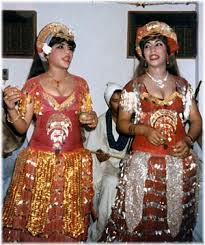

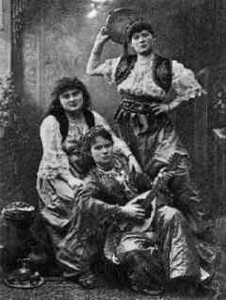


Trying to capitalize on the Oriental Dance craze, Thomas Edison made several films featuring Oriental Dancers. Many Hollywood productions followed which further popularized "Oriental Dance" although not always on the most fair and positive way.
However, Hollywood did make a significant contribution to this dance costume. Inspired by the European vaudeville and burlesque outfits, Hollywood designers created a fringed, beaded, sparkling bra and belt set, which was adopted first by the Egyptian dancers in 1930s, and later by the rest of the Middle Eastern dance community.
As so, the dancing style changed because of the need to please a foreign audience and modern Raqs Sharqi was born.
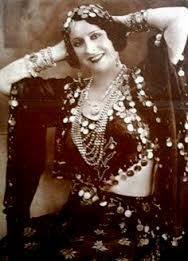
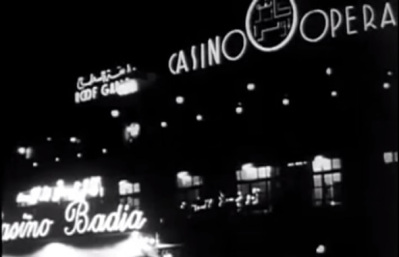
One of the most famous nightclubs of this type was the one that belonged to Badiia Masabni in Cairo during the 1920s. In this setting, dance was adapted to the stage, set choreographies and group performances were introduced and also there was a big influence from western types of dance, such as ballroom dancing and ballet. The costumes changed as well. Up until that point dancers wore a wide long skirt, a shirt and a waistcoat. From the 1920s dancers started wearing what is known today as the typical Oriental Dancer’s costume (bedlah): a bra, a skirt, bare midriff, veils, a lot of glitter and beads.
Up till this point, there was no traditional dance costume. In fact, native garb covered and concealed the contours of the body, with only a scarf or belt tied around the hips to highlight the movements.
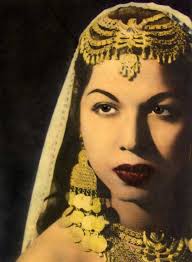
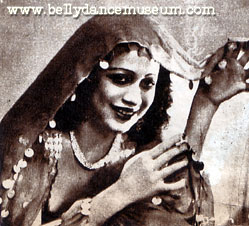
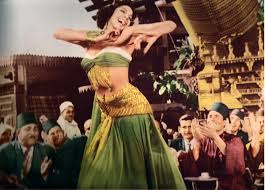
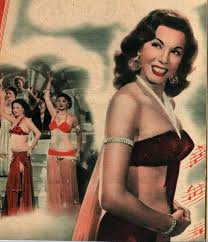
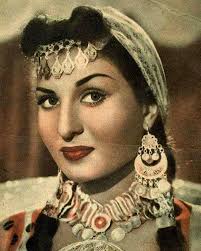
In the 1930s and 1940s the booming Egyptian film industry produced many musicals that featured Oriental Dance artists. During that time such legendary dancers as Samia Gamal, Tahiya Karioka, and Naima Akef, who started their carriers at the Casino Opera club, rose to fame and eventually gained international recognition.
There were some public and religious figures in Egypt and in other North African and Middle Eastern countries who considered Raks Sharki indecent and morally objectionable. After the last Ottoman ruler of Egypt, King Farouk, was overthrown in 1952, the new government representative Dr. Rageb banned Raks Sharki on religious grounds. It soon became clear that Raks Sharqi was one of the biggest forces attracting international tourism to Egypt. More importantly, Oriental Dance was an integral part of Egyptian culture. Due to economic and social pressure the ban was lifted in 1954 but there were several restrictions which are still in effect: the stomach has to be covered; floor work is prohibited; a specific “quivering” shimmy is banned.















CONQUERING THE WORLD - A GOBAL FORM OF ART
Raks Sharki was quickly adopted by many Middle and Near Eastern countries and developed into several distinct styles. When immigrants from Turkey, Iran, and the Arab states began to immigrate to New York in the 1930s and 1940s, dancers started to perform a mixture of these styles in the nightclubs and restaurants. This fusion came to be identified as Classic Cabaret or (American Cabaret) Oriental Dance.
Oriental Dancecontinues to evolve and offers an inspiring variety of dance styles which often incorporate elements of ballet, modern, jazz, Latin, Flamenco, and Indian dance. Some of the most prominent dance styles include Egyptian, Turkish, Lebanese, Greek and Gypsy.
Currently, Oriental Dance, as a Middle Eastern performing art, is a record of several Historical and Artistic influences resulting in (in)numerable concepts.
Such concepts are the result of a rich vocabulary that allows us to express ourselves freely through organic and fluid movements, thus creating our own body language.
Alongside the anthropological aspects, Oriental Dance carries in itself all the Glamour, Mysticism and Culture of the Middle East, that transcends us through its bustling rhythms and melodies which inebriastes our Soul, Body and Mind.
Definitely, Oriental Dance has now become a part of international pop culture. Its rich and controversial History contributes to its allure. Today this art form is as multi-faceted as the world community that helped shape it. It can provide a way to express ourselves, serve as a workout regimen, be a part of meditative practice, offer opportunities to make friends and connect with others, and of course, bring great joy. It is truly a dance for every one.
What we call today Oriental Dance it is a traditional folk dance and performing art from Middle Eastern, Near Eastern, Asian, North African and Mediterranean countries being Turkey and Egypt the vanguard leaders of the modality.
In fact Egypt was, and still is, considered the performing arts core of Middle East only to be compared to Hollywood (and in past times even bigger!).

Maryem Sahar.
Sources:
Photos: Google
***IF YOU KNOW ABOUT ANY UNMENTIONED AUTHORS AND COPYRIGHTS PLEASE DO CONTACT MARYEM AS SHE WIL BE MORE THAN HAPPY TO ADD IT TO HER POST'S SOURCES**





Comments